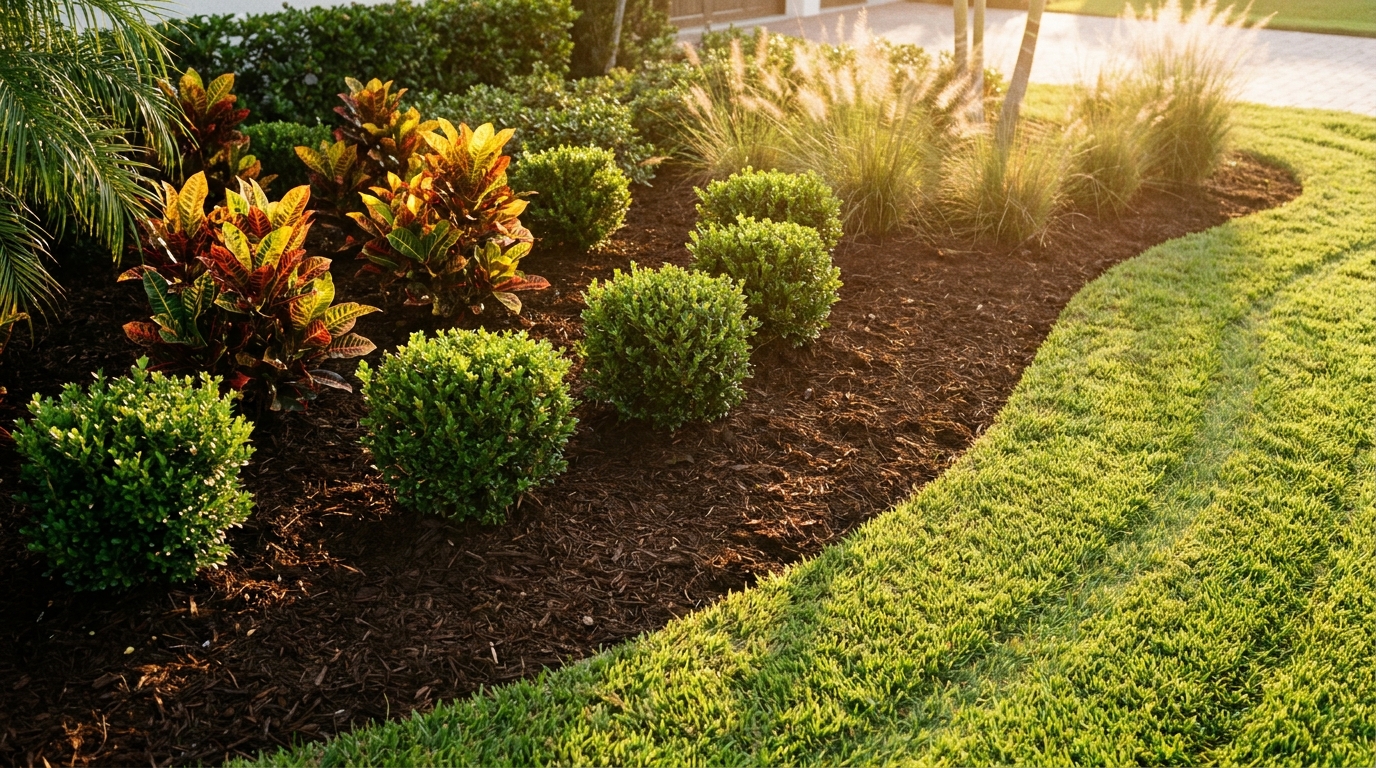
Fresh Mulch: The Cheapest Upgrade Your House Can Get
Nothing changes curb appeal per dollar like fresh beds and a spade-cut edge. Depth, timing, and the volcano mistake that kills trees.
Stand across the street from your house and look at it like a buyer. The lawn might be fine — but if the beds are faded, weedy, and blurred into the grass, the whole property reads "tired." Fresh mulch and a crisp edge fix that in an afternoon, for less than almost any other upgrade you can buy.
What mulch is actually doing
- Holding water — beds stay moist days longer between waterings.
- Blocking weeds — a proper layer shades out most weed seeds before they start.
- Feeding soil — as it breaks down, it builds the dark, living soil Florida sand desperately lacks.
- Framing the picture — dark mulch against green turf is the contrast that makes both look intentional.
The numbers
2–3 inches deep. Less does nothing; more suffocates roots. In Florida heat, mulch breaks down fast — plan on refreshing about once a year, and the beds usually tell you by looking grey and thin.
The volcano mistake
Mulch piled in a cone against a tree trunk — the "mulch volcano" — holds moisture against bark, invites rot and pests, and slowly kills the tree it's supposed to flatter. Keep mulch a few inches back from trunks and stems. Flat beds, clean gaps.
The edge is half the effect
A spade-cut edge — that clean trench line where bed meets lawn — is what makes a yard look professionally kept. It's also the first thing to blur. We re-cut bed lines on rotation (point 4 of the Golden Cut checks beds every visit) because a sharp edge does more for curb appeal than most plants do.
Want it handled instead?
Every Golden Grass visit runs the 9-Point Golden Cut — cut, edges, beds, irrigation eye-check and all — with photo proof to your phone. If it's not right, we re-do it free within 48 hours.
Claim My First Golden Cut